
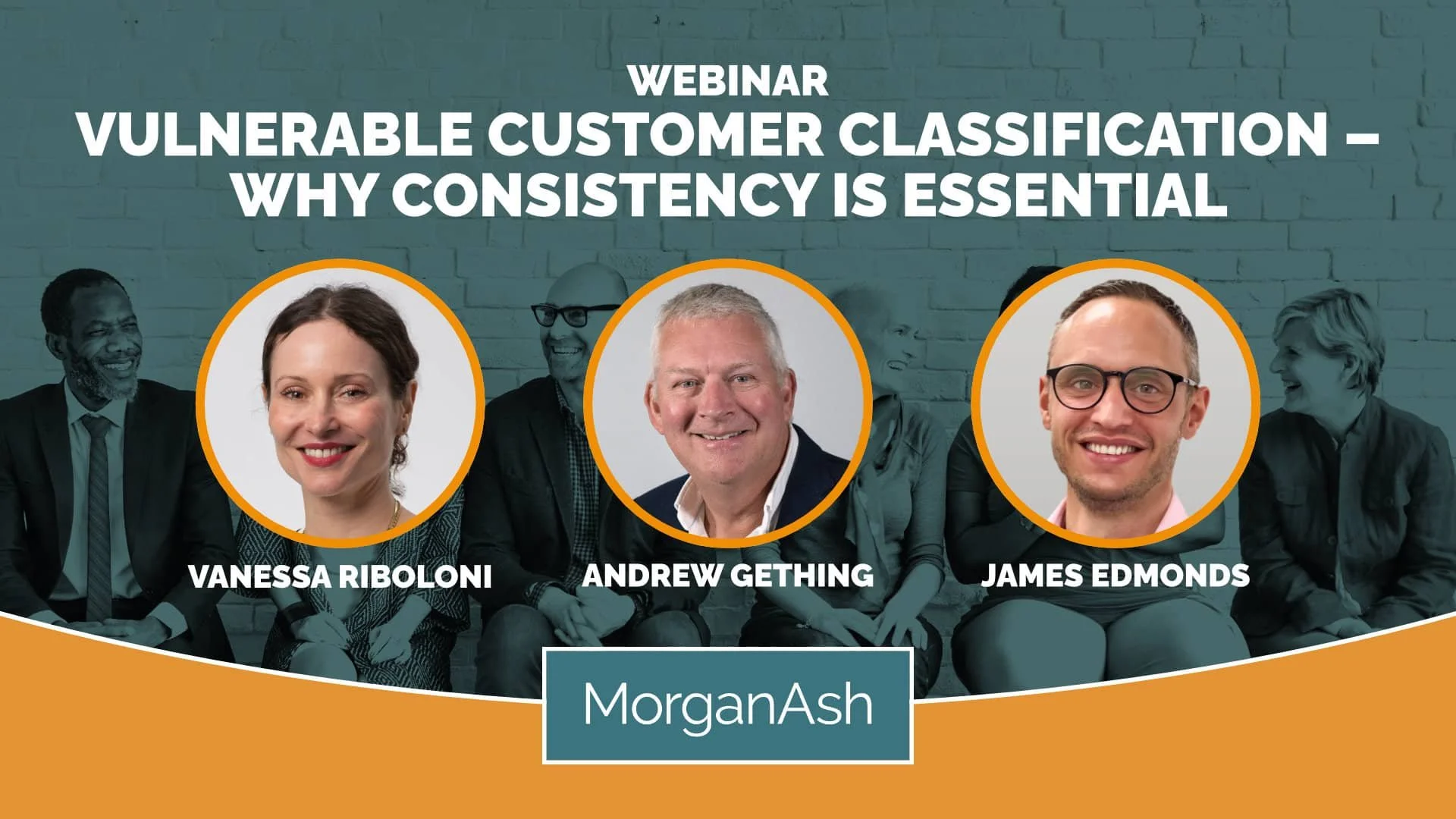
This webinar explores the need for a consistent approach to communicating customer vulnerabilities.
When people make judgments about another person’s characteristics, those judgments are shaped by personal experience and often reflect unconscious bias—or even prejudice—in vague and imprecise ways. For example, phrases like “slightly deaf” or “seems a bit down” don‘t provide much useful information.
What’s needed is an objective assessment, a structured way to measure identified vulnerability characteristics, and a shared vocabulary to express them. This ensures consistent data that everyone can understand.
In this webinar, we break down these challenges and show how organisations can move beyond subjective descriptions to a robust, objective, and consistent means of communication.
Overview
The problems with individuals’ subjective decision-making
Subjective versus objective decisions
Why consistency is needed
The need for a common vocabulary, or classification lexicon, that everyone understands
The difference between recording an individual’s vulnerability characteristics and recording their needs
Why MARS uses a Resilience Rating—what it is, what it does, and how it works
Why someone isn’t inherently vulnerable: assessments need to identify characteristics of vulnerability alongside products, as it is the interaction between the two that creates the potential for poor outcomes
Using digital systems, human agents, and even healthcare professionals to identify and classify vulnerabilities
Privacy and GDPR implications
Understanding vulnerabilities within family groups
Communicating how the compounding effect of multiple issues can create greater vulnerability
Why consistent classification is vital to ensure meaningful reporting
Guest
Our guest this month is Vanessa Riboloni, Head of Research and Insight at the Chartered Insurance Institute (CII), where she leads research initiatives that support the development of professional standards, good practice, and advocacy across the insurance and financial planning sectors. Vanessa was the driving force behind the CII’s vulnerable customer management guidance, published in November 2026, much of which focuses on the need for structured data underpinned by objective identification and supported by a common vulnerability lexicon.

Vanessa Riboloni
Vanessa is Head of Research and Insight at the Chartered Insurance Institute, where she leads research initiatives that to support the development of professional standards, good practice and advocacy across the insurance and financial planning sectors. She manages the All-Party Parliamentary Group on Insurance and Financial Services, facilitating policy dialogue between sector and government.

Andrew Gething
Andrew is the founder and managing director of MorganAsh. He is a recognised consumer vulnerability specialist and champion, is the driving force behind the award-winning consumer vulnerability management tool, MARS.

James Edmonds
Consumer Duty consultant James works with firms in the financial services sector, to help them understand and overcome the many customer vulnerability challenges with the FCA’s Consumer Duty regulations. James has extensive knowledge in customer experience, of which identifying, supporting and communicating with vulnerable customers is a key component. James has operated in customer experience and strategy roles primarily in financial services for nearly 20 years, having worked at L&G, RSA, More Than, JUST, James Hay and Nucleus.
Next webinar
In our next webinar, scheduled for 23 April, we examine how customers’ vulnerabilities can be managed and monitored over time, particularly across product lifetimes. This includes the role of good, structured data, supported by the objective classification techniques covered in this session.